
Scent discrimination

Scent discrimination is a dog's ability to identify and recognize a specific scent among many other scents in the environment. Simply put, it is a dog's ability to distinguish the "right scent" from all the others.
Discrimination means that a dog:
Accepts the assigned scent (scent sample).
Forms it as a priority sensory pattern.
Compares this pattern with the scent field of the environment.
Follows only the matching profile.
In other words, the dog does not follow the freshest trail, or the mass human background, or a random scent.
An individual human scent is a complex chemical profile that includes volatile organic compounds (VOCs), skin microparticles, bacterial products, and surface deposits.
A dog's olfactory system contains hundreds of millions of receptors and a developed olfactory epithelium area, which provides extreme sensitivity to molecular differences in odors.
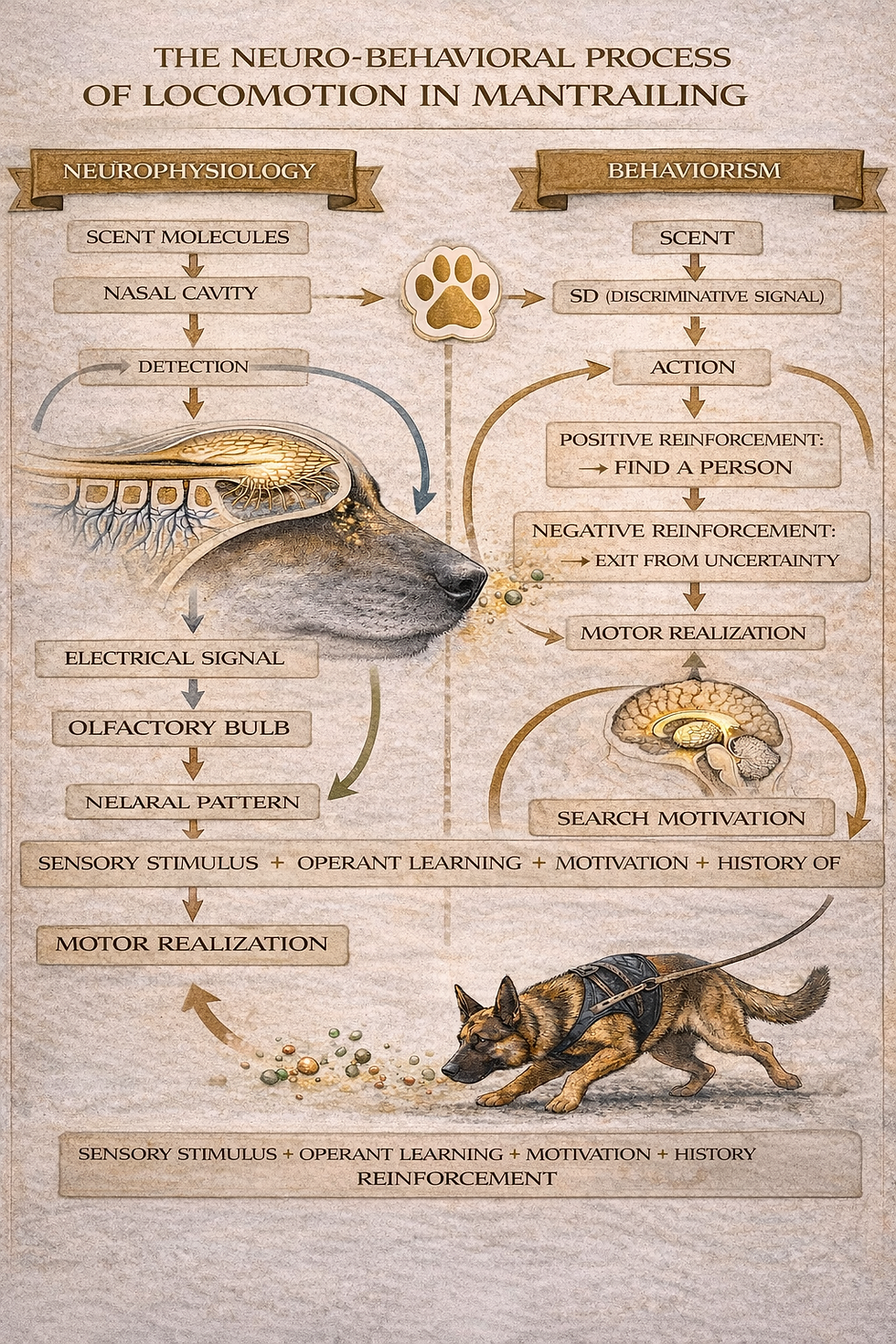
When a dog is presented with a scent article, the scent molecules enter the nasal cavity, bind to the olfactory receptors, the signal is transmitted to the olfactory bulb, and a unique neural pattern is formed. This pattern is recorded as a target template, and the dog's brain "remembers" this profile.
During the process, the dog continuously compares the incoming scent information with the target neural pattern—this is the mechanism of sensory recognition. When the profile matches, the brain's orientation and motor centers are activated, which manifests itself in changes in locomotion and indications.
Discrimination abilities are genetically determined, but they are also significantly influenced by training.
As a result of competent training, the target scent becomes a conditioned stimulus for the dog: a match of the scent profile leads to reinforcement. The desired behavior is reinforced through repeated successful searches.
A stable behavioral chain is formed: smell → analysis → match → movement → result → reinforcement.
Incorrect training can reinforce undesirable alternative strategies. For example, focusing on people's movements, dependence on a leash, searching for the freshest trail, visual pursuit, and so on.
A high level of discrimination is especially important for trailing dogs:
1. in urban environments, where there are many people, intersecting routes, and a high degree of environmental pollution (contamination) with various smells.
2. When working on old trails, when the shape of the scent cone changes, the scent becomes fragmented; if secondary scent fields have formed, the scent is carried away by turbulence.
3. When working at mass events where there is a mixture of odors from dozens or hundreds of people.
4. When searching for a specific person, when the search is complicated by one's own contamination or when there is a common odor or a duplicate odor in the work area (for example, the odor of the missing person's clothing worn by another person during the search (especially with a common odor), the odor of a twin).
In conditions of complex aerodynamics, the scent can be fragmented, carried by turbulent flows, and form secondary accumulation zones.
This increases the requirements for the accuracy of discrimination and the stability of the dog's behavioral algorithm.
Discrimination is not movement based on the freshest scent, movement based on guesswork, visual pursuit, reaction to people's movements, or following the handler's signals. These are all alternative strategies that are not related to the analysis of the target scent.
Good discrimination can be said to exist if the dog exhibits the following behavioral characteristics:
- ignoring extraneous traces,
- confident return after checking,
- stable retention in contamination,
- no "sticking" to random people or smells,
- maintaining the direction of movement without prompts.
It is important to note that without discrimination, trailing turns into a fun run with a dog, into a "search for any person." And, accordingly, it loses its practical meaning. With discrimination, however, trailing becomes "pursuing a specific person by their individual scent." This is the foundation of reliable applied trailing work.

If we reduce the definition of discrimination to a formula, it might look like this:
Odor discrimination =
recognition of target profile
+background scent ignoring
+
trailing by odor profile match.
BY SERVICE DOGS. Irina Brunina

Comments