
NSI. Csaba Gránicz, INBTI Instructor

NSI – When There Is Nothing to Follow
One of the less visible yet extremely important skills of mantrailing-trained dogs is the so-called NSI (No Scent Indication): when the dog clearly communicates to the handler that there is no outgoing track connected to the scent article at the starting point.
This information is crucial during a search. A well-executed NSI allows us to exclude directions, areas, and intersections, saving significant time, energy, and human resources.

Why is this task difficult for the dog?
At first glance, it may seem logical: if there is no scent, the dog simply will not go. However,
reality is more complex.
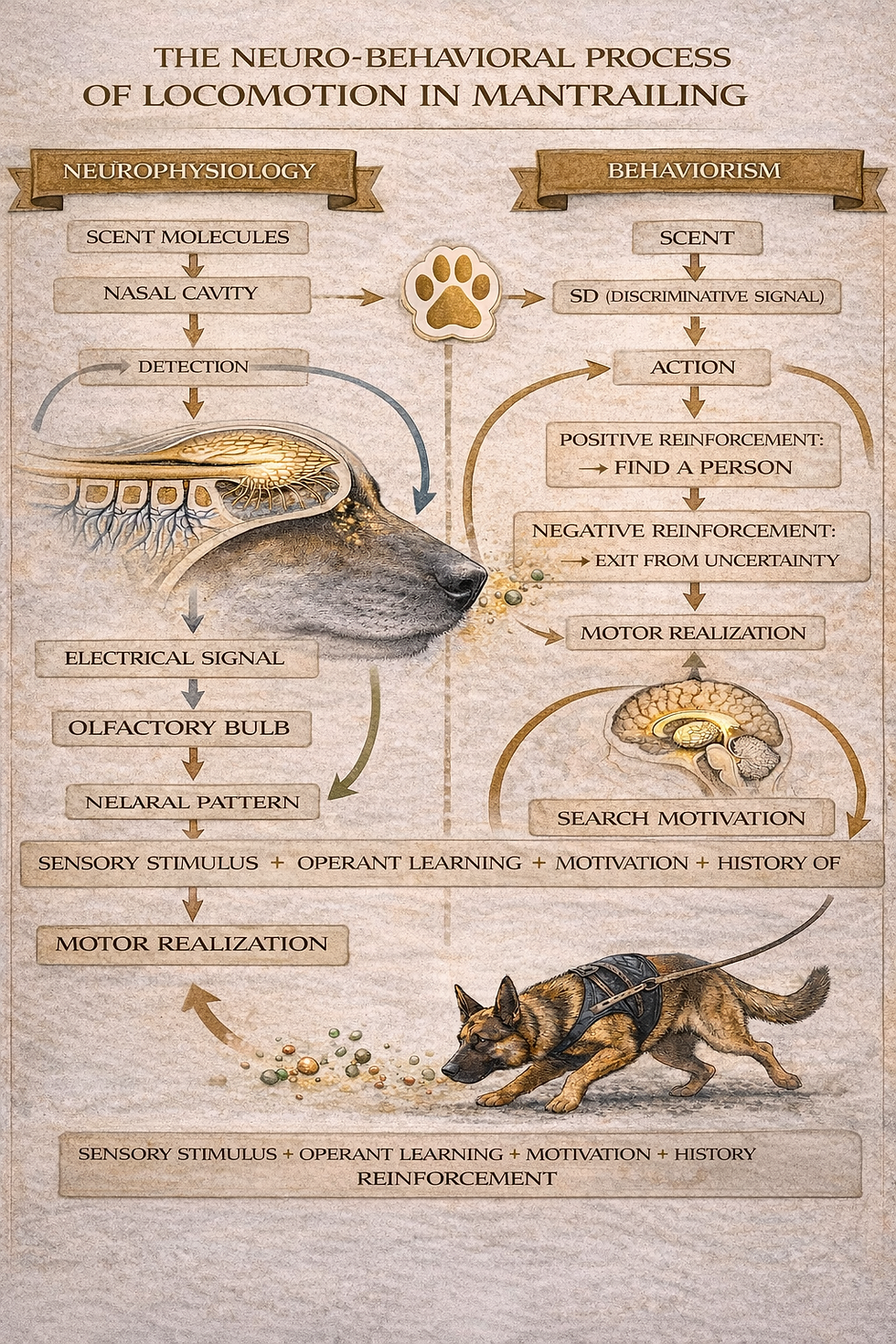
Let’s consider what we teach our dogs during mantrailing:
they receive a scent article,
start from a given point,
follow the target scent,
and at the end, there is always a person and a reward.
In the dog’s mind, this forms a very simple rule:
“If I follow the scent, I get a reward.”
So far, the dog has never been rewarded for not following anything. As a result, when placed in an NSI situation, the dog instinctively begins to search. First at the starting point, then by
expanding the search area in the hope of “catching” the track. This behavior is completely natural.
What do we need to teach during NSI training?
The essence of NSI training is helping the dog understand that:
it can also be successful by showing that there is nothing to follow.
In other words, not going anywhere can be the correct decision—and this decision should be followed by the same reward and reinforcement.
It is essential that during training we do not reinforce searching behavior, but instead clearly communicate to the dog that continued searching does not lead to success.
How should we teach it?
There are many different approaches. Some trainers physically prevent the dog from moving away from the start point, while others guide the dog around the start area to “show” that the
scent is not present anywhere.
I believe in experiential learning. I believe the dog should be allowed to experience the absence of the target scent on its own, both at the starting point and in the surrounding area.
Knowledge gained through experience is far more stable than knowledge gained by being shown every step.
There are two key aspects to focus on:
1. Thorough initial check of the start area
At the beginning of the task, always guide the dog carefully around the starting point so it can build its own “scent map.” It is important that this procedure does not differ from your usual routine, as dogs are extremely sensitive to even the smallest changes.
2. Reinforcing the negative indication
When the dog excludes a direction or clearly indicates the absence of scent, verbally praise the dog. This builds confidence and helps the dog feel secure in making decisions.
Initially, do not expect a clear indication. It is sufficient if the dog looks at you, communicating: “I don’t smell it.” Later, as the task becomes clearer to the dog, a distinct NSI signal will emerge—often the same indication the dog uses when locating a person.
With more experienced dogs, it can even be useful to “question” their decision by sending them back to search again. This further strengthens confidence and commitment to their decision.
How often should we practice NSI?
Although NSI is extremely important, it should not be overtrained. If practiced too frequently, there is a risk that during a difficult track the dog may offer an NSI indication instead of investing effort into solving the problem.
In my opinion, for an experienced dog, one NSI-type exercise every 2–3 months is
sufficient.
Csaba Gránicz, INBTI Instructor

Comments